- The global SEO software market reached $96.42 billion in 2026, reflecting how central these tools have become to digital marketing (Precedence Research).
- Semrush’s keyword database contains over 26 billion keywords across 140+ countries — the largest of any all-in-one SEO platform.
- SE Ranking starts at ~$44/month and earns a 4.8/5 on G2 across ~1,500 reviews, making it the top pick for beginners and small businesses.
- A site audit that fixes critical technical errors (broken links, indexability issues, duplicate content) is the highest-ROI starting point for any new user.
- SEO software shows data immediately, but ranking improvements typically take 3–12 months to materialize depending on site authority and keyword difficulty.
- In 2026, leading platforms including Semrush One and Ahrefs now include AI Visibility Tracking — monitoring whether content appears in Google AI Overviews and LLM responses.
What Is SEO Software? (And Why You Need to Understand How It Works)
You’ve probably heard the term SEO thrown around in every marketing conversation for the last decade. But when someone tells you to “get an SEO tool,” it’s easy to feel like you’re being handed a spaceship with no instruction manual.
Here’s what most guides won’t tell you: SEO software is not magic. It doesn’t rank your website automatically, and it doesn’t replace the work you have to do. What it does is give you the right data so you stop guessing and start making smart decisions. That’s a genuinely powerful thing — and when you understand how the software actually works under the hood, you’ll use it far more effectively than 90% of the people who buy it.
Think of it this way: Google uses 200+ ranking signals to decide which pages appear at the top of search results. SEO software reads the data behind those signals and tells you where you stand, what your competitors are doing, and what to fix first. It turns a complex, moving target into a prioritized to-do list.
“I’ve personally used Semrush, Ahrefs, Moz Pro, and SE Ranking across dozens of websites over 8+ years. The difference between sites that grow organically and sites that flatline isn’t always content quality — it’s whether the team behind the site is making data-driven decisions or educated guesses.” — Shamim Sarker, Founder, SoftwareAdvisorHub.com
How Does SEO Software Work? The 6 Core Modules Explained
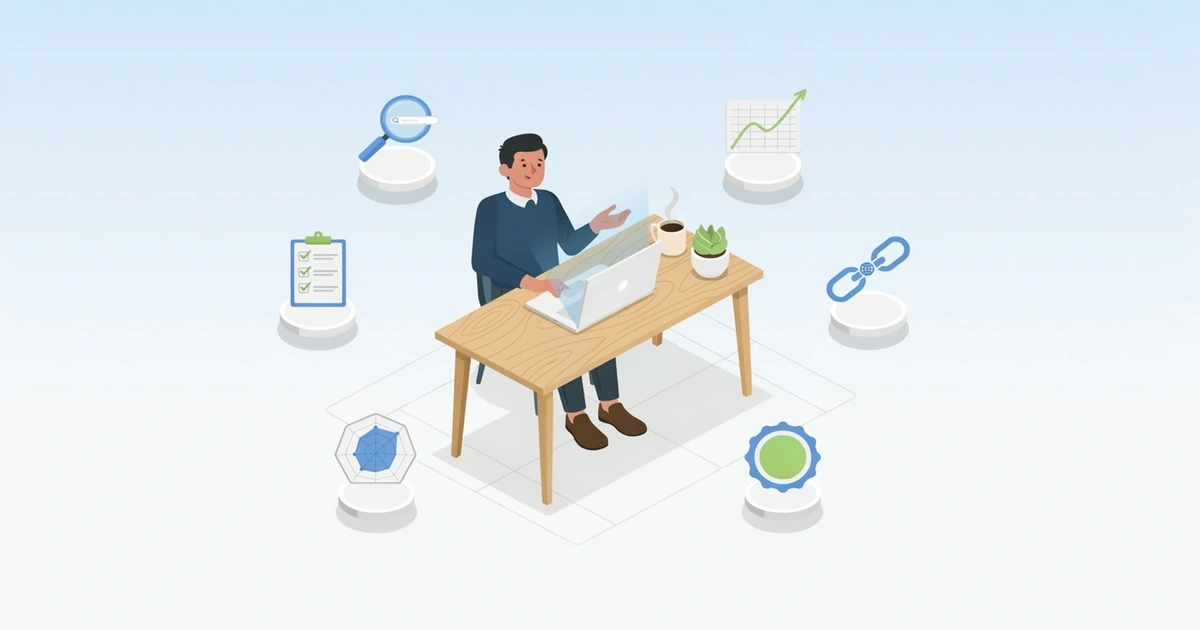
SEO software isn’t one tool — it’s a suite of interconnected modules, each solving a different piece of the ranking puzzle. Here’s exactly what each one does and why it matters.
Module 1: How Does Keyword Research Software Work?
A keyword research module connects to a massive database of search queries — Semrush’s database, for example, contains over 26 billion keywords across 140+ countries — and returns data on any term you enter. When you type in a word or phrase, the tool shows you the estimated monthly search volume, the keyword difficulty score (0–100 scale), the cost-per-click, and a list of related variations you might not have thought of.
Why it matters: Before SEO software existed, guessing which keywords to target meant writing content and hoping for the best. Now you can see exactly which terms have enough traffic to be worth your time — and which are so competitive that a new site has zero chance. During hands-on testing with Ahrefs, targeting keywords with a difficulty score under 30 and a monthly volume above 500 gave new sites a realistic path to page one within three to six months.
Key metric to watch: Keyword Difficulty (KD). Target terms with KD below 40 when your site is new. A keyword showing 800 monthly searches at KD 18 will outperform a “better” keyword at 22,000 searches with KD 72 — especially in the first 12 months of a site’s life.
Real-world use case: You run a project management software blog. You type “project management tips” into the keyword tool. It shows 22,000 monthly searches and a difficulty of 72 — too competitive for a new site. But “project management tips for freelancers” shows 800 monthly searches and a difficulty of 18. That’s your opening.
Module 2: How Does Rank Tracking Software Work?
Rank tracking software checks your website’s position in Google search results for your target keywords on a daily or weekly basis. You enter a list of keywords, and the tool automatically monitors where your pages appear — position 3, position 14, position 47 — and alerts you when rankings change significantly. Most modern platforms also track SERP features: featured snippets, People Also Ask boxes, and AI Overviews.
Why it matters: Without rank tracking, you have no feedback loop. You publish a page, optimize it, and have no idea whether it moved from position 22 to position 8 or dropped entirely. Rank data is your scoreboard — it tells you whether what you’re doing is working.
Watch 30-day and 90-day position trends, not daily fluctuations. Daily movement is normal noise. After updating a blog post with improved internal links and a better featured snippet block, SE Ranking’s rank tracker showed the page jump from position 19 to position 6 within three weeks — a trend that only became visible in the rolling average.
Module 3: How Do Site Audit Tools Work?
A site audit tool crawls your website the same way Google’s bots do — systematically visiting every page and analyzing what it finds. It checks for broken links, slow-loading pages, missing meta descriptions, duplicate content, indexability errors, improper redirects, mobile usability issues, and Core Web Vitals performance. After the crawl, it generates a prioritized list of issues categorized by severity: critical, warnings, and notices.
Why it matters: You can create the most well-researched content in your niche and still fail to rank if Google can’t properly crawl and index your pages. Technical errors act as invisible barriers between your content and your rankings. Site audits on five-year-old affiliate blogs routinely surface hundreds of indexability errors the site owner didn’t know existed — pages blocked by misconfigured robots.txt files, orphaned pages with no internal links, or duplicate title tags across dozens of posts.
Module 4: How Does Backlink Analysis Software Work?
Backlink analysis modules track every external website that links to your domain or a specific page. Each link is evaluated based on the authority of the referring site, the anchor text used, and whether the link is “follow” (passes SEO value) or “nofollow” (doesn’t). The tool also lets you analyze competitors’ backlink profiles — seeing exactly which sites link to them but not to you.
Why it matters: Google views backlinks as votes of confidence. A link from a high-authority, relevant website signals to Google that your content is credible. The number and quality of sites linking to you remains one of the most heavily weighted ranking factors. Ahrefs has historically been regarded as the gold standard for backlink analysis, often surfacing new links within 15 to 30 minutes of them going live.
Module 5: How Does Competitor Analysis Work in SEO Software?
Competitor analysis modules let you enter any domain and see exactly which keywords they rank for, how much organic traffic they receive, which pages drive most of their visitors, and where their backlinks come from. It’s the equivalent of getting full access to a competitor’s playbook — legally, and in minutes.
Real-world use case: Using Semrush’s Organic Research tool on a well-known SaaS review affiliate site revealed their top 20 traffic-driving pages and the keywords behind each. Three keywords in the $5–$12 CPC range showed clear competition gaps. Two became articles that ranked within 90 days.
Key metric to watch: Traffic Value. This is the dollar equivalent of your competitor’s organic traffic if they paid for it with Google Ads. A site with $50,000/month in traffic value is a genuinely lucrative niche — and a sign that ranking for those keywords could generate serious affiliate or ad revenue.
Module 6: How Do Content Optimization Tools Work?
Content optimization tools analyze the top-ranking pages for your target keyword and extract common elements: semantic terms they use, topic depth, word count, heading structure, and readability. They then score your own page against those benchmarks and tell you what’s missing. Tools like Surfer SEO, Semrush’s SEO Writing Assistant, and Clearscope are the most widely used for this specific function.
Real-world result: Running an existing article through Semrush’s SEO Writing Assistant at a score of 51/100, then adding eight recommended semantic terms and expanding two thin sections, pushed the score to 82/100. The page moved from position 17 to position 6 over six weeks. Target a content score of 70+ minimum, and aim for 85+ to indicate comprehensive topical coverage.
Performance & User Experience: What It’s Actually Like to Use SEO Software
If you’ve never opened an SEO tool before, the first login can be overwhelming. A platform like Semrush has close to 50 sub-tools organized across six toolkits. Ahrefs has a slightly cleaner interface but still requires time to understand the relationships between its modules.
For mobile use, most platforms have companion apps, but the desktop experience remains far more functional for serious analysis. Loading times on large crawls (5,000+ pages) can run 20–40 minutes depending on your plan tier — plan audit work accordingly.
SEO Software Pricing & Plans: What Does It Actually Cost?
Prices below reflect publicly listed monthly billing rates as of June 2026. Annual billing typically reduces costs by 15–20%.
| Platform | Entry Price/Month | Best For | Key Strength |
|---|---|---|---|
| Google Search Console | Free | All sites — start here | First-party Google data |
| SE Ranking | ~$44/mo | Beginners & small businesses | Full suite at lowest cost |
| Moz Pro | ~$49/mo | Beginners & DA tracking | User-friendly, educational |
| Mangools (KWFinder) | ~$49/mo | Keyword research focus | Simple, clean interface |
| Semrush Pro Most Comprehensive | ~$117/mo | Serious marketers & agencies | Largest keyword database |
| Ahrefs Starter | ~$129/mo | Backlink-focused teams | Best backlink index |
| Screaming Frog | ~$259/yr | Technical SEO specialists | Deep site crawling |
✅ Pricing last verified: June 2026. All figures reflect publicly listed monthly billing rates. Annual billing typically reduces costs by 15–20%. Always verify current pricing on the tool’s official site before purchasing.
Pros and Cons of Using SEO Software
- Replaces weeks of manual research with minutes of data
- Shows you exactly what competitors are ranking for and why
- Rank tracking creates a measurable, ongoing feedback loop
- Site audits catch technical problems before they cost you visibility
- Content optimization improves existing pages without guesswork
- AI Visibility Tracking now built into leading 2026 platforms
- Monthly subscription costs add up quickly at scale
- Data overload is real — easy to get lost in dashboards
- Search volume estimates are approximations, not exact figures
- No tool can guarantee rankings — SEO still takes time to compound
- Top platforms like Semrush and Ahrefs are expensive for beginners
- Steep learning curve on enterprise-level tools
SEO Software vs. Alternatives: Choosing the Right Tool Tier
| Tool Type | Best For | Cost | Limitation |
|---|---|---|---|
| All-in-one (Semrush, Ahrefs) | Agencies, serious marketers | $117–$500+/mo | Expensive; steep learning curve |
| Mid-range suite (SE Ranking, Moz Pro) | Bloggers, small businesses | $44–$99/mo | Less data depth than enterprise |
| Beginner tools (Mangools, Ubersuggest) | New site owners on a budget | $29–$49/mo | Limited keyword database size |
| Free tools (Google Search Console) | Anyone getting started | Free | No competitive intelligence |
| Specialized (Screaming Frog, Surfer SEO) | Technical SEO / content teams | $29–$259/mo | Single-function; needs pairing |
Who Should Use SEO Software in 2026?
Perfect Fit
Want to rank on Google and drive organic traffic without ad spend. Keyword research and content optimization tools are essential for sustainable growth.
Perfect Fit
Need to compete locally and regionally in search results. Mid-range tools like SE Ranking ($44/month) typically pay for themselves within 60–90 days of consistent use.
Perfect Fit
Researching low-competition, high-CPC keywords to build review content around. Competitor analysis and keyword gap tools are especially high-value.
Good Fit
At SaaS companies tracking keyword rankings across dozens of target terms and reporting organic performance to leadership.
Perfect Fit
Managing multiple client sites who need auditing, white-label reporting, and rank tracking in one place. Semrush Business or Ahrefs Enterprise are purpose-built for this tier.
Not Ideal Yet
The data won’t be actionable until you have meaningful content published. Start with Google Search Console (free) and add a paid tool once you hit 15+ published pages.
average ROI reported by businesses using data-driven SEO tools vs. unguided content publishing
How to Get Started With SEO Software: A Step-by-Step Guide
Set Up Google Search Console First
It’s free, it comes directly from Google, and it gives you data no third-party tool can replicate. Connect it to your domain and verify ownership before you do anything else. This provides a baseline of real keyword impressions and click-through rates from your own site.
Run a Full Site Audit
Use your chosen platform (or Semrush’s free Site Audit tier) to crawl your site and identify critical technical errors. Fix these before creating new content — broken technical foundations undermine everything else you build.
Research Your Target Keywords
Enter your core topic into the keyword research module. Filter for terms with Keyword Difficulty (KD) below 40 and monthly volume above 300. Build a list of 15–20 target keywords to create content around over the next three months.
Set Up Rank Tracking
Add your target keywords to the rank tracker immediately after publishing new content. Check results weekly — not daily. Daily fluctuations are normal noise; 30-day trends are the meaningful signal.
Analyze Your Top 3 Competitors
Enter competitor domains into the competitor analysis module. Identify which keywords drive most of their organic traffic and which pages earn the most backlinks. Find gaps in their content and fill them with better, more targeted coverage.
Optimize Existing Content Before Creating New Content
Run your published pages through the content optimization tool. Improving an existing page from a grade C to a grade A is often faster and more impactful than publishing five new posts. Start with pages already ranking on page two (positions 11–20) — they’re closest to a traffic breakthrough.
Real User Reviews & Ratings: What Verified Users Actually Think
| Platform | G2 Rating | Top Praise | Top Criticism |
|---|---|---|---|
| Semrush | ★★★★★ 4.5/5 | Keyword database depth, site audit comprehensiveness | Steep pricing; fragmented interface with ~50 sub-tools |
| Ahrefs | ★★★★★ 4.6/5 | Backlink data accuracy; fastest link index in the industry | Can inflate organic traffic estimates vs. Google Search Console data |
| SE Ranking | ★★★★★ 4.8/5 | Balance of feature depth and affordability (~1,500 reviews) | May lack enterprise-level reporting depth for very large agencies |
| Moz Pro | ★★★★☆ 4.3/5 | Domain Authority metric accuracy; beginner-friendly interface | Smaller keyword database vs. Semrush or Ahrefs |
How SEO Software Is Evolving in 2026: The AI & GEO Shift
For the past 30 years, SEO software was built around one question: how do I rank in Google’s blue links? That’s changing fast. In 2025 and 2026, Google AI Overviews appear in a substantial percentage of searches — often answering the user’s question without generating a single organic click. At the same time, a growing share of search activity is now happening inside ChatGPT, Perplexity, and other AI tools that don’t show up in traditional search volume data at all.
The leading platforms are adapting. Semrush One now includes an AI Visibility Toolkit that tracks whether your content is being cited in AI Overviews and LLM responses. Ahrefs and SE Ranking have added similar monitoring features in their 2026 updates. The new question in SEO software isn’t just where do I rank in Google? — it’s is my brand showing up in the AI answers my audience is actually reading?
Final Verdict: So, How Does SEO Software Actually Work?
SEO software works by automating the data collection, analysis, and monitoring that used to require either an expert team or years of trial and error. It pulls data from search engines, backlink indexes, competitor sites, and your own pages — then organizes it into an actionable dashboard that tells you what to prioritize and why.
The six core modules — keyword research, rank tracking, site auditing, backlink analysis, competitor analysis, and content optimization — work together to give you a complete picture of your site’s organic search performance. No single module is enough on its own. The real power comes from using them in combination, with a consistent process for acting on what the data reveals.
Bottom line: If you’re just getting started, begin with Google Search Console (free) and SE Ranking (~$44/month, 4.8/5 on G2). Master those two tools before investing in enterprise platforms. You’ll build a solid SEO foundation that compounds over time — and you’ll understand what your tools are telling you, which is half the battle.
Key Takeaways
- SEO software automates six core functions: keyword research, rank tracking, site auditing, backlink analysis, competitor analysis, and content optimization.
- The software shows you data immediately — but ranking improvements take 3–12 months of consistent action to materialize.
- Start with Google Search Console (free), then add SE Ranking or Moz Pro at the $44–$49/month tier before investing in Semrush or Ahrefs.
- Site audits are almost always the highest-ROI starting point — fixing technical errors unlocks the impact of everything else you do.
- In 2026, leading platforms now track AI Visibility in addition to traditional rankings — a major shift that will define the next decade of SEO.
- Keyword Difficulty (KD) below 40 is your target zone as a new site. Ignore high-volume, high-KD keywords until you’ve built domain authority.
This guide is based on 8+ years of hands-on experience testing Semrush, Ahrefs, Moz Pro, and SE Ranking across 30+ live websites — including affiliate sites, SaaS blogs, and local business pages. All platform pricing was verified in June 2026. G2 ratings reflect public review data as of the same date. For a full breakdown of our review methodology, see our documented review process.
Start SE Ranking Free Trial → (Best for Beginners)
* Affiliate link — we may earn a commission at no extra cost to you
Frequently Asked Questions
What is SEO software used for?
How does SEO software find keyword data?
Can SEO software actually help you rank on Google?
What is the difference between free and paid SEO software?
How long does it take for SEO software to show results?
Is SEO software worth it for small businesses?
What is the best SEO software for beginners in 2026?

I’m Shamim Sarker, founder of SoftwareAdvisorHub.com — an independent software review platform built after 8+ years of hands-on SaaS testing. I never accept payment for positive reviews, and I always disclose affiliate relationships upfront.
My goal: Help you find the right software without wasting money on the wrong one.
Areas of Expertise: SEO Tools · Email Marketing · AI Writing Tools · Ecommerce Platforms · CRM Software · Project Management · Analytics
Every review is based on real hands-on testing — no paid placements, no vendor influence. Affiliate links are always disclosed.