Affiliate Disclosure
This post contains affiliate links. We may earn a commission at no extra cost to you. We only recommend software we’ve tested and trust.
Informational Guide

- There are four core types of lead generation: inbound, outbound, paid, and referral.
- Most B2B marketers report success using content marketing as a lead generation channel.
- Contacting a new lead within 5 minutes produces dramatically higher contact rates than waiting even 30 minutes.
- Referral leads commonly close significantly faster than cold outbound leads.
- Businesses with structured lead scoring typically see meaningful improvements in close rate.
Introduction
You’ve built something worth buying. The problem is almost nobody knows it exists yet, and even the people who stumble across it aren’t ready to buy the moment they land on your site. That gap — between “found you” and “bought from you” — is exactly what lead generation is built to close.
If you’ve ever downloaded an ebook in exchange for your email, signed up for a free trial, or filled out a “request a demo” form, you’ve been on the receiving end of a lead generation strategy. You didn’t buy on the spot — but a business captured enough of your interest and contact information to keep the conversation going. That’s the entire discipline in a nutshell, and it’s arguably the single most important marketing function for any business whose product isn’t an impulse buy.
The confusing part is that “lead generation” gets used as an umbrella term for a dozen different tactics — cold email, SEO content, paid social ads, referral programs, trade show booths — that don’t have much in common except the end goal. That makes it easy to copy a tactic that worked for someone else’s business without understanding why it worked, and then wonder why it flops for yours.
This guide breaks down what lead generation actually means, how B2B and B2C approaches differ, what it costs, and how to build a process that brings in people who are genuinely likely to buy — not just names sitting unused in a spreadsheet.
What Is Lead Generation?
Lead generation is the process of identifying, attracting, and capturing the contact information of people or businesses that have shown interest in what you offer. A “lead” is that person or company once they’ve taken a specific action — filling out a form, starting a free trial, requesting a quote — that signals real interest, as opposed to someone who just happened to click a link.
Not every lead is created equal. Most marketing teams sort leads into three buckets:
- Qualified lead: Has shown clear intent and fits your target customer profile. Worth immediate sales attention.
- Warm lead: Has expressed some interest but hasn’t confirmed fit or urgency yet. Needs nurturing before a sales conversation makes sense.
- Unqualified lead: Doesn’t match your target customer or shows no real buying intent. Usually filtered out early.
This sorting matters because chasing every lead equally wastes time. A lead generation system that can’t tell a qualified prospect from a curious browser isn’t actually doing its job — it’s just collecting names.
Types of Lead Generation
There isn’t one way to generate leads. Most businesses use a mix of the following four approaches, weighted differently depending on their audience and budget.
Inbound Lead Generation
Inbound means the prospect comes to you — through a blog post they found on Google, a piece of content they shared, or a tool they discovered organically. It relies on content marketing, SEO, and social media to pull people in rather than push a message out.
Inbound leads tend to take longer to convert but arrive with higher trust, since the prospect chose to engage rather than being interrupted. It can take months of consistent publishing before organic content produces meaningful volume, which is why inbound works best as a long-term investment.
Most inbound programs rely on a CMS or SEO platform to plan content, and a CRM built for lead tracking paired with email automation tools for lead nurturing to convert readers once they convert.
Outbound Lead Generation
Outbound flips that — you’re proactively reaching out via cold email, cold calls, LinkedIn outreach, or targeted ads. It’s faster to get in front of the right person, especially in B2B, where you can target a specific job title at a specific company.
The tradeoff is lower response rates and a higher risk of feeling intrusive if the targeting or messaging is off. Outbound works best when it’s narrow and personalized — a highly targeted list of 100 relevant prospects usually outperforms a scraped list of 10,000.
Paid Lead Generation
Paid channels — Google Ads, LinkedIn Ads, Meta Ads — buy visibility instead of earning it. This is the fastest way to generate volume, since you can start driving traffic to a landing page within hours of launching a campaign. Cost per lead can climb quickly in competitive categories, and paid leads often need more nurturing since they haven’t built the same trust as organic or referral traffic.
Paid works especially well for testing new offers quickly — validating a headline, offer, or landing page before investing months into organic content built around the same message.
Referral & Word-of-Mouth Lead Generation
Existing customers, partners, or affiliates send new prospects your way. Referral leads convert at meaningfully higher rates than cold outbound in most industries, because someone the prospect already trusts has vouched for you.
The catch is that referral volume is harder to control or scale on demand — you can’t force customers to refer people, though structured incentive programs can make it easier and more rewarding for them to do so.
| Type | Speed to Results | Typical Trust Level | Best For |
|---|---|---|---|
| Inbound | Slow (months) | High | Long-term, sustainable growth |
| Outbound | Fast (days–weeks) | Low–Medium | Precise B2B targeting |
| Paid | Fast (days) | Medium | Quick volume, testing offers |
| Referral | Variable | Very High | High-trust, high-conversion sales |
B2B vs. B2C Lead Generation
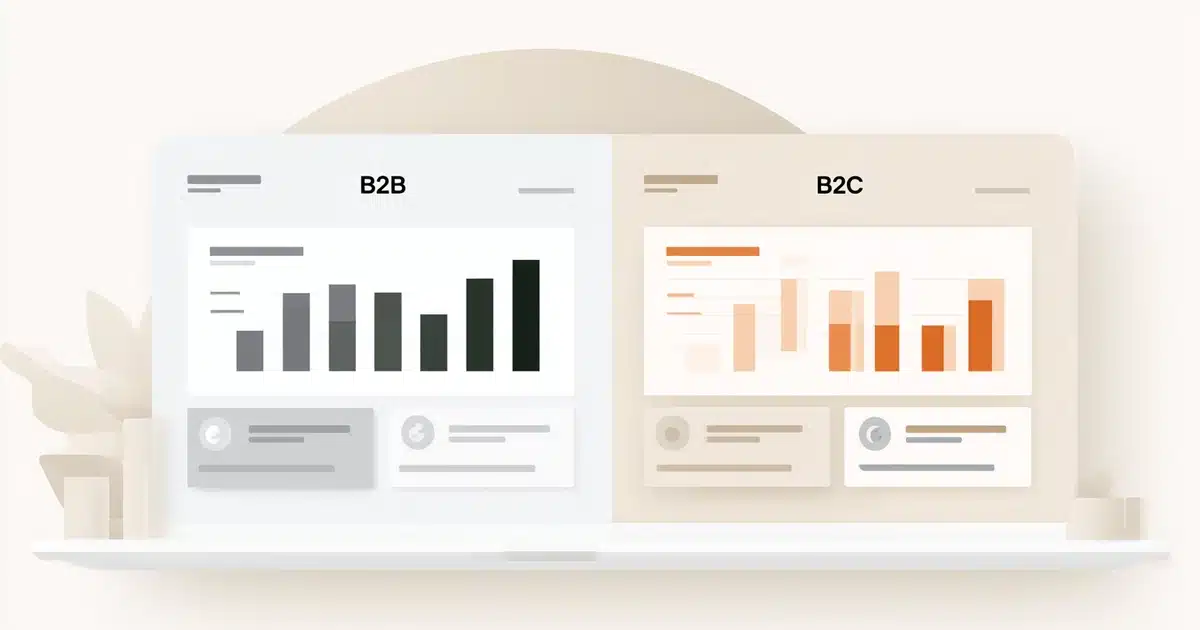
The mechanics of “capture interest, get contact info, follow up” are the same in B2B and B2C, but almost everything else — who’s involved, how long it takes, and what convinces someone to convert — is different.
| Factor | B2B Lead Generation | B2C Lead Generation |
|---|---|---|
| Decision maker | Often multiple people (buying committee) | Usually one individual |
| Sales cycle | Weeks to months | Minutes to days |
| Primary channels | LinkedIn, email, webinars, referrals | Social ads, search, marketplaces |
| Content style | Whitepapers, case studies, demos | Reviews, social proof, discounts |
| What converts | ROI, efficiency, risk reduction | Price, convenience, emotion |
| Lead volume needed | Lower volume, higher value per lead | Higher volume, lower value per lead |
If you’re selling project management software to a 50-person company, you’re likely dealing with a champion, a budget-holder, and possibly IT — and the deal might take two months to close. If you’re selling a $40 skincare product, the entire journey from ad click to purchase might take three minutes. Neither approach is “harder,” but a strategy built for one will usually flop if you copy-paste it onto the other.
This is also where a lot of small businesses get their strategy wrong: they run B2B tactics (long nurture sequences, gated whitepapers) on what’s actually a B2C purchase decision, or they try to close a B2B deal with single-touch urgency tactics that work for impulse consumer purchases. Matching your approach to how your buyer actually makes decisions matters more than which channel is trendy.
The Lead Generation Process in Practice
Regardless of channel, most lead generation follows the same underlying funnel:
- Attract — Content, ads, or outreach bring a stranger’s attention to your business. This is the widest part of the funnel; its only job is earning attention from roughly the right audience.
- Engage — A landing page, offer, or conversation gives them a reason to keep paying attention. A clear value proposition matters more than clever copy here.
- Capture — They exchange contact information for something of value: a free trial, a guide, a quote. Every extra form field lowers your conversion rate.
- Qualify — You determine whether this lead actually fits your target customer and has real buying intent, via automated scoring or manual review.
- Nurture — Email sequences, retargeting, or sales follow-up keep qualified leads engaged until they’re ready — B2B buyers in particular often take weeks to decide.
- Convert — The lead becomes a customer. A good process feeds data back into earlier stages so you can see which channels and offers actually produced customers, not just leads.
The stage most businesses underinvest in is qualification. A sales rep spending an hour on a call with someone who was never going to buy is a far more expensive mistake than a marketing team spending ten minutes setting up a qualification question on a form.
Lead Generation Costs & Budgeting
Cost per lead (CPL) varies enormously by industry, channel, and how competitive your keywords or audience are. As a rough framework:
- Referral and organic content leads tend to have the lowest direct cost per lead, but require sustained investment in content or relationship-building over time before they pay off.
- Paid search and social leads usually sit in a moderate range for most small businesses, though highly competitive B2B software categories can push CPL much higher.
- Outbound (cold email/calling) leads carry labor cost rather than ad spend, so the “cost” shows up as time rather than a media bill.
A simple way to calculate your own CPL: divide total spend on a campaign by the number of leads it generated. If you spent $2,000 on a campaign and got 100 leads, your CPL is $20. That number only tells half the story — a $20 lead that never buys is more expensive than a $60 lead that converts into a $2,000 sale. Always weigh CPL against lead quality and downstream conversion rate.
A more useful number for budgeting is cost per acquisition (CPA) — what you spent to actually win a customer, not just capture a lead. If your CPL is $20 and only 1 in 20 leads converts, your real CPA is $400. Tracking both numbers side by side tells you whether a channel is cheap-but-inefficient or expensive-but-effective.
When budgeting for the first time, start small on two channels, run them for four to six weeks, and compare CPL and CPA before committing a larger budget to either one. Guessing at scale before you have real data almost always costs more than a modest, deliberate test.
Benefits and Challenges of Lead Generation
| Benefits | Challenges |
|---|---|
| Builds a predictable pipeline instead of relying on luck | Takes time to see results, especially with inbound |
| Lets you target the exact audience most likely to buy | Requires ongoing investment — content, ads, or outreach don’t run themselves |
| Creates measurable data to improve marketing spend | Poor targeting produces low-quality leads that waste sales time |
| Scales more predictably than referrals alone | Rising privacy regulations make some outbound and ad tactics harder |
| Shortens the sales cycle when leads are well-qualified | Easy to over-invest in volume instead of quality |
The businesses that get the most value from lead generation treat it as a system to refine, not a campaign to “finish.” The ones that struggle usually chase volume metrics instead of the metrics that actually predict revenue.
Common Lead Generation Mistakes to Avoid
- Optimizing for volume over fit. 500 leads sounds better than 50 — until the 50 convert at 10x the rate because they were actually qualified.
- Slow follow-up. A lead that hears back within minutes is dramatically more likely to engage than one that waits a day or two.
- Too much friction at capture. Long forms or forced account creation suppress conversion rates unnecessarily.
- No nurture sequence for leads that aren’t ready yet. Without follow-up, most of them are simply lost.
- Ignoring the data. Without tracking which channel actually produces paying customers, it’s impossible to know where to invest more.
Lead Generation vs. Demand Generation vs. Sales Prospecting
These three terms get used interchangeably, but they’re not the same thing.
- Lead generation focuses on capturing contact information from interested prospects — the goal is a name, email, or phone number tied to demonstrated interest.
- Demand generation is broader and happens earlier — it’s about building awareness of a problem and your solution before someone is even looking to buy.
- Sales prospecting happens after lead generation — it’s the sales team’s active outreach to leads (or cold prospects) to move them toward a deal.
Demand generation makes people aware a problem — and a solution — exists. Lead generation captures the people who are now interested enough to raise their hand. Sales prospecting takes it from there and pushes toward a close.
A practical example: a company publishing a podcast about industry trends, with no explicit product pitch, is running demand generation. When that same company later offers a free assessment tool in exchange for an email address, that’s lead generation. When a sales rep reaches out to that email list to book a call, that’s prospecting.
Who Needs a Lead Generation Strategy?
Needs It
Any sales cycle longer than a single visit needs a system to keep prospects warm.
Needs It
Contractors, agencies, and consultants that rely on inbound inquiries rather than walk-in traffic.
Often Needs It
Running paid ads, where capturing an email before the first purchase increases lifetime value.
Often Needs It
Real estate, financial services, education — where the buying decision takes more than one visit to close.
It matters less for businesses with instant, low-consideration purchases — a convenience-store snack doesn’t need a lead nurture sequence. If your product requires research, comparison, or approval from someone other than the buyer, lead generation is the mechanism that keeps prospects from disappearing while they think it over.
The common thread across all of these is a gap between “first contact” and “ready to buy.” Wherever that gap exists, lead generation is the system that keeps the relationship alive long enough to close it.
How to Get Started With Lead Generation
Define your ideal customer profile
Be specific about company size, role, budget, or demographic — vague targeting produces vague leads.
Pick one or two channels to start
Don’t try inbound, outbound, paid, and referral all at once. Match the channel to where your audience already spends time.
Create a clear offer
A free trial, downloadable guide, consultation, or discount — something valuable enough that a stranger will trade their contact info for it.
Build a simple capture mechanism
A landing page with one clear form, not a five-field maze. Every extra field lowers your conversion rate.
Set up basic qualification criteria
Even a simple lead-scoring rule (company size, budget range, urgency) prevents your sales team from chasing dead ends.
Follow up fast, then nurture consistently
Leads that get a response within minutes convert at meaningfully higher rates than those that wait hours or days. After the first touch, an email sequence keeps warm leads engaged until they’re ready.
If you’re evaluating software to help run this process — CRMs for tracking leads, email automation tools for nurturing, or landing page builders for capture — that’s a natural next step once your strategy is defined rather than the first thing to buy.
One more thing worth planning for before you launch: how you’ll review results. Set a recurring check-in — weekly at first, then monthly once the process stabilizes — to look at how many leads each channel produced, how many were qualified, and how many converted.
What Marketers Say: Industry Benchmarks & Survey Data
A few data points are worth knowing before you build your own process:
- Content marketing works. The large majority of B2B marketers report successfully using content marketing to generate leads, making it one of the most consistently effective inbound tactics available.
- Speed of follow-up matters more than almost anything else. Contacting a new lead within five minutes can produce dramatically higher contact rates than waiting even 30 minutes — the drop-off after the first half hour is steep.
- Referrals convert faster. B2B referral leads are commonly reported to close significantly faster than cold outbound leads, since a trusted introduction skips much of the trust-building work.
- Lead scoring pays off. Companies that implement structured lead scoring typically see meaningful improvements in close rate compared to treating every lead the same.
The consistent theme across these benchmarks: quality and speed beat raw volume. A smaller number of well-qualified, quickly-followed-up leads tends to outperform a large pile of cold, slow-nurtured ones.
Industry data also points to AI and automation as a growing part of how lead generation runs day to day — from AI-assisted lead scoring to chatbots that qualify inbound inquiries in real time. That doesn’t change the underlying fundamentals covered in this guide, but it does mean the tools available to execute on them are evolving quickly.
Key Takeaways
- Lead generation is the system that connects “someone found us” to “someone bought from us” — it’s not a single tactic.
- The four core types — inbound, outbound, paid, referral — each trade off speed, trust, and cost differently.
- B2B and B2C lead generation share the same mechanics but differ almost everywhere else: decision-makers, sales cycle, and what converts.
- Qualification is the most underinvested stage — filtering for fit early saves your sales team time later.
- Speed of follow-up and lead scoring consistently outperform raw lead volume.
Lead generation isn’t a single tactic — it’s the system that connects “someone found us” to “someone bought from us.” The businesses that do it well don’t necessarily use more channels than everyone else; they qualify better, follow up faster, and treat their process as something to continuously refine rather than a box to check once.
If you’re just getting started, resist the urge to run every channel at once. Pick the one or two that fit where your audience already is, build a clear offer, and get disciplined about qualifying and following up.
Frequently Asked Questions
What is lead generation in simple terms?
What are the 4 types of lead generation?
What is an example of lead generation?
What is the difference between lead generation and demand generation?
How do you generate leads for B2B?
What is a qualified lead?
I’m Shamim Sarker, founder of SoftwareAdvisorHub.com — an independent software review platform built after 8+ years of hands-on SaaS testing. I never accept payment for positive reviews, and I always disclose affiliate relationships upfront.
My goal: Help you find the right software without wasting money on the wrong one.
Areas of Expertise: SEO Tools · Email Marketing · AI Writing Tools · Ecommerce Platforms · CRM Software · Project Management · Analytics
Every review is based on real hands-on testing — no paid placements, no vendor influence. Affiliate links are always disclosed.