This post contains affiliate links. We may earn a commission at no extra cost to you. We only recommend software we’ve tested and trust.
Informational Guide

By SoftwareAdvisorHub Editorial Team
- 87% of marketers used generative AI in a recurring workflow in 2026, up from 51% two years earlier (Salesforce).
- Only 17% of AI-using marketers have received any formal, job-specific AI training.
- Just 6% of marketing teams report AI fully embedded into their workflows (Supermetrics).
- 52% of marketing teams still don’t own a clear data strategy, which stalls most AI use cases before they start.
- Predictive retention models are linked to churn reductions in the 15-25% range once at-risk customers are flagged early.
Why This Matters More in 2026 Than It Did Two Years Ago
Separate industry data backs this up: only about 6% of marketing teams report having AI fully embedded into their workflows, and 52% still don’t own a clear data strategy — which quietly stalls almost every AI use case before it starts, per Supermetrics’ 2026 Marketing Data Report. In other words, most marketing teams have the tools. Very few have the understanding underneath them. This article closes that specific gap — not by teaching you to code, but by giving you the same mental model that separates marketers who direct AI well from marketers who just type more prompts into more tools. If you’re ready to put that understanding to work, our guide to choosing the right AI tool for your business is a good next stop.
Why “How Does AI Work” Actually Matters for Marketers
You don’t need to understand neural networks to use an AI tool effectively — but if you’re using AI to write copy, segment audiences, score leads, or automate campaigns, having a rough model of what’s happening under the hood changes how you use it. You’ll write sharper prompts, catch bad output faster, and stop treating the tool like a slot machine you pull and hope.
The Four-Step Process Behind Every AI Tool
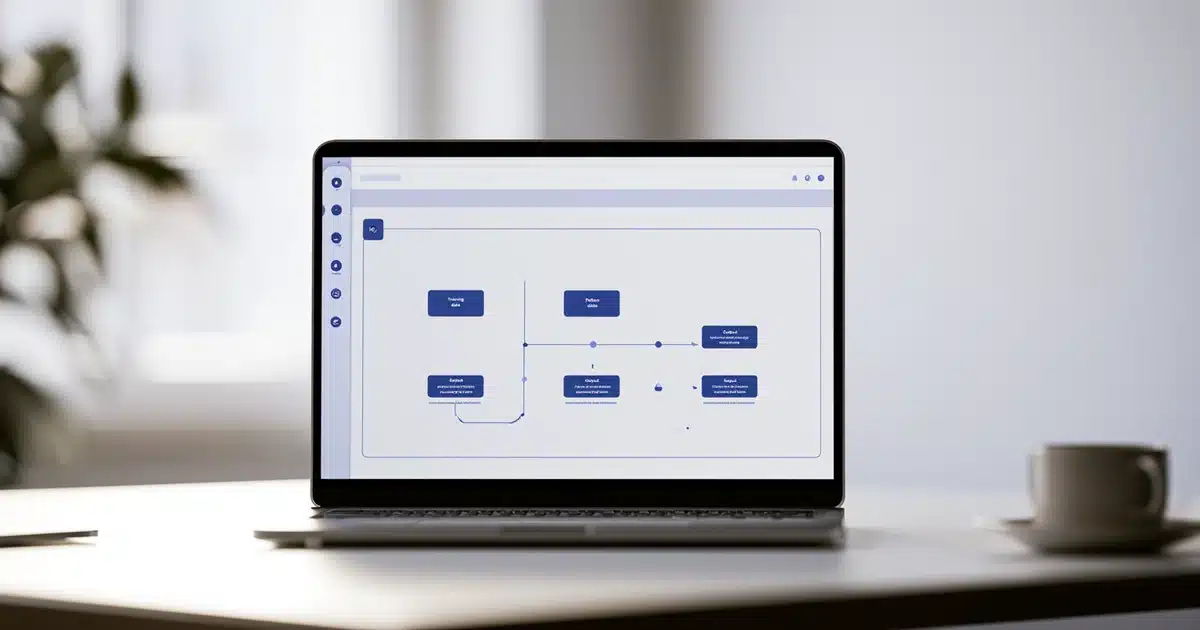
Strip away the branding, and nearly every AI marketing tool — a chatbot, a subject-line generator, an ad-targeting engine, a churn-prediction dashboard — runs the same underlying loop.
1. Training: The Model Learns From Examples
Before you ever type a prompt, the AI has already studied an enormous number of examples relevant to its purpose — articles, ad copy, customer records, images. It isn’t memorizing this content; it’s learning statistical relationships in it, such as which words commonly follow other words, or which customer behaviors commonly precede a purchase or a cancellation.
2. Input: You Give It a Starting Point
This is your prompt, your uploaded dataset, or your customer list. The quality of your input shapes the quality of the output almost entirely. A vague prompt like “write something about our shoes” gives the model almost nothing specific to match patterns against. A prompt like “write a 100-word Instagram caption for a 25-35 year old audience, promoting free shipping on running shoes, upbeat and casual tone” gives it real constraints to work within.
3. Pattern-Matching and Prediction
The model compares your input against everything it learned during training and calculates the most statistically likely next word, pixel, segment, or recommendation. It isn’t “thinking” the way a person does — it’s running a very sophisticated prediction engine, one step at a time, based on probability rather than understanding.
4. Output and Refinement
The tool produces a result — a paragraph, an image, a segmented audience list, a forecasted churn score. Most modern tools let you push back on that output: regenerate, adjust tone, add a constraint, exclude an example. Every adjustment feeds back into another round of prediction, which is why iterative prompting almost always beats a single one-shot attempt.
- Training: The model studied thousands of past email subject lines and their open rates.
- Input: You provide the campaign topic, audience, and a tone (“urgent but not spammy”).
- Pattern-matching: It predicts word combinations statistically associated with high open rates for similar campaigns.
- Output: You get 5-10 subject-line options, and you pick, edit, or regenerate.
Once you can walk through that loop for any tool you use, the tool stops feeling like a black box.
A tool is only as good as the constraints you feed it — vague input produces vague output, every time.
Generative vs. Predictive vs. Agentic AI
The defining shift in 2026 marketing AI is the move from generative AI — tools that draft — to agentic AI, tools that act on your behalf rather than simply producing a suggestion for you to approve. Understanding the difference between the three main categories helps you know what you’re actually getting from a given tool.
| Predictive AI | Analyzes historical data to forecast a future outcome — e.g., flagging which leads are likely to convert or which customers are likely to churn |
|---|---|
| Generative AI | Creates new content — text, images, audio, video — based on a prompt, like drafting ad copy or email subject lines |
| Agentic AI | Takes multi-step action toward a goal, often with minimal human input per step — e.g., an agent that pulls competitor ads, summarizes them, and drafts a positioning brief unprompted |
Instead of spending hours manually configuring segmentation rules, some 2026 platforms now build and update audience segments automatically as users move through lifecycle stages — marketers describe what they need in plain language, and the AI generates the underlying logic itself. That’s agentic behavior in practice: less “AI helped me draft this,” more “AI handled this end-to-end while I supervised.”
The Core AI Vocabulary Marketers Actually Need
You don’t need a data science vocabulary. You need these terms, because they show up constantly in tool documentation and vendor pitches.
| Natural Language Processing (NLP) | The branch of AI focused on understanding and producing human language — what lets a tool “read” your prompt at all |
|---|---|
| Predictive Analytics | Using historical data patterns to forecast a future outcome, like which customers are likely to churn |
| Prompt | The instruction you give an AI tool — specificity here is the single biggest lever on output quality |
| Training Data | The examples a model studied before you ever used it; its quality and scope shape everything the tool later produces |
| Agentic AI | AI that takes multi-step action toward a goal with limited human input at each step, rather than just generating one output for approval |
| Human-in-the-Loop | A workflow design where a person reviews or approves AI output before it goes live — the core safeguard against AI’s confident mistakes |
Where This Actually Shows Up in Your Marketing Stack
Once you can see the four-step loop, it’s easier to recognize it inside the tools you already use — and to understand why they behave the way they do.
Content generation. Tools apply pattern-matching to language specifically. You give a prompt, the model predicts a likely sequence of words based on marketing copy it has seen before, and you get a draft. This is why prompt specificity matters so much — a detailed brief gives the model real constraints to match against instead of guessing at what you meant. See our tested picks in AI writing assistants if you want to try this category hands-on.
Workflow automation. Some platforms now read real behavior and performance signals continuously, build and update audience segments automatically, choose send timing and frequency, and optimize campaigns in real time — compressing what used to take hours of manual configuration into minutes. Our marketing automation software reviews cover several tools built specifically for this.
Audience segmentation and churn prediction. Traditional lead scoring was rule-based — points for job title, company size, number of interactions. AI-driven scoring instead recognizes patterns across thousands of signals. On the retention side, industry analyses of automated, prediction-triggered retention workflows report churn reductions in the 15-25% range once a model flags at-risk customers before they cancel.
Dashboards and reporting. Instead of building reports manually, some 2026 tools let you describe what you want in natural language and generate the chart or dashboard outline for you, which you then refine with point-and-click adjustments. This is one corner of a broader shift — see our AI productivity tools guide for how it plays out across the rest of your workflow.
Answer engine visibility (AEO). A newer category of tools tracks how a brand appears across AI answer engines like ChatGPT, Google AI Overviews, and Perplexity — surfacing real buyer questions, citation rates, and messaging gaps. This runs on the same underlying mechanics we cover in how AI SEO software works, just pointed at answer engines instead of classic search results.
Recognizing the shared mechanism across all of these is genuinely useful: once you know a tool is fundamentally a prediction engine, you stop expecting it to intuit your business the way a colleague would, and you start feeding it the specific, constrained input it actually needs to perform well.
Why AI Tools Get Things Wrong
AI tools don’t verify facts — they predict statistically likely output. That distinction explains almost every frustrating AI mistake you’ll encounter.
- Specific, constrained prompts
- A named person reviewing output
- Clean, centralized data
- Confident, unverified statistics
- Messy or biased training data
- Vague prompts, generic output
It’s confident, not correct. A model can generate a fluent, well-formatted, entirely wrong statistic with the same confidence it generates a correct one, because “confidence” here just means “statistically likely,” not “verified true.” Every factual claim in AI output needs independent checking before it reaches a customer.
Human review is not optional. The more autonomous a tool becomes — moving from generative to agentic — the more a human checkpoint matters, not less. A bad first draft is a nuisance. A bad autonomous action is already done.
Common Myths Marketers Still Believe About AI Tools
AI Readiness Checklist for Marketing Teams
Before adding another AI tool to your stack, a short self-audit saves far more time than it costs — worth running through this even before you start comparing options in our guide to the 7 types of AI tools for marketers:
- Do we have clean, centralized data for the specific task we want AI to help with?
- Is there a named person responsible for reviewing AI output before it reaches a customer?
- Have we defined what “good output” looks like for this use case, in writing?
- Do we know which category of AI we’re using — generative, predictive, or agentic?
- Is there a documented rollback plan if an automated workflow produces something wrong?
If most of these are “no,” the fix isn’t a better AI tool — it’s answering these questions first.
Getting Started: A 5-Step Framework
Pick one task, not one tool
Start with a single repetitive task — first-draft copy, subject-line variants, campaign reporting — rather than overhauling your entire stack at once.
Write specific prompts
Include audience, tone, format, and goal every time. Treat it like briefing a capable but literal-minded new hire, not searching Google.
Always review before publishing
Treat every AI output as a fast first draft, not a finished asset — especially anything involving a statistic, a claim, or a customer-facing promise.
Track what’s actually saving you time
Not every AI feature earns a permanent place in your workflow. Keep what measurably helps; drop what just adds a step.
Add autonomy gradually, and only after trust is earned
Move from a tool that drafts, to a tool that recommends, to a tool that acts — only once you’ve verified its output is reliable at the previous stage.
Key Takeaways
- Every AI tool runs the same loop: training, input, pattern-matching, output.
- Specific prompts beat vague ones — every time, across every tool category.
- Agentic AI needs more human oversight, not less, as autonomy increases.
- AI adoption is high (87%); AI training is low (17%) — that gap is the real opportunity.
Bottom Line
The gap between AI adoption and AI proficiency — 87% usage against just 17% formal training — is the real story of AI marketing in 2026, not the tools themselves. The teams pulling ahead aren’t the ones with the most AI subscriptions; they’re the ones who understand, at a basic mechanical level, what these tools are actually doing — and who still keep a human checkpoint between prediction and publication. Understanding beats tool-hoarding every time.
Sources
- Salesforce, State of Marketing 2026 — generative AI workflow adoption data.
- Loopex Digital, 2026 marketing AI skills research — formal AI training rates among marketers.
- Supermetrics, 2026 Marketing Data Report — AI workflow embedding and data-strategy ownership data.
- Industry analyses of automated, prediction-triggered retention workflows (e.g., DigitalApplied, 2026) — churn-reduction ranges from predictive AI interventions.
Frequently Asked Questions
Do I need to know how to code to use AI marketing tools?
What’s the difference between AI and machine learning?
What’s the difference between generative and agentic AI?
Why does my AI tool sometimes give wrong or generic answers?
Can AI tools understand my brand voice?
How do I know if an AI-generated output is trustworthy?
Is my marketing team behind on AI adoption?
I’m Shamim Sarker, founder of SoftwareAdvisorHub.com — an independent software review platform built after 8+ years of hands-on SaaS testing. I never accept payment for positive reviews, and I always disclose affiliate relationships upfront.
My goal: Help you find the right software without wasting money on the wrong one.
Areas of Expertise: SEO Tools · Email Marketing · AI Writing Tools · Ecommerce Platforms · CRM Software · Project Management · Analytics
Every review is based on real hands-on testing — no paid placements, no vendor influence. Affiliate links are always disclosed.